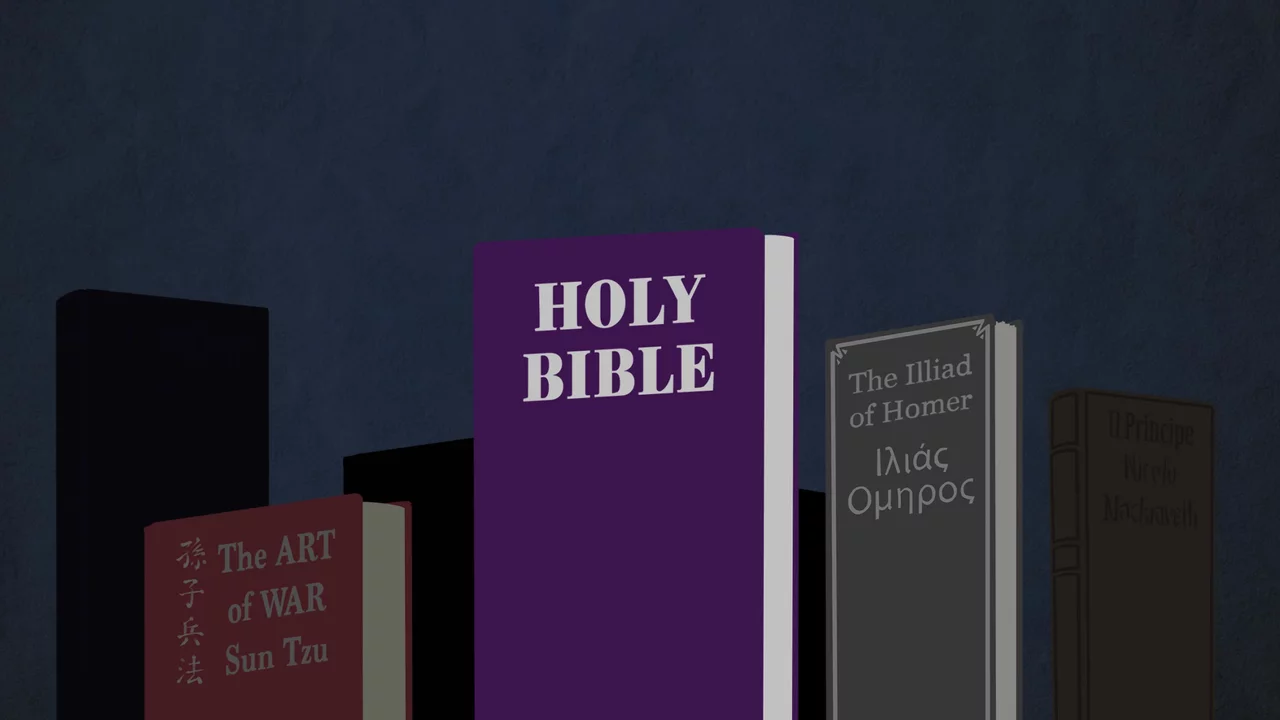
The Bible.
It's one of the most influential books in human history.
It explores the big questions of why we exist.
It's inspired many people to do amazing things.
And confused many others.
You've probably got one sitting around somewhere.
So what is the Bible actually?
Well, the Bible is a small library of books that all emerged out of the
history of the people of ancient Israel.
In one sense, they were just like any other ancient civilization.
But among them were a long line of individuals called prophets,
and they viewed Israel's story as anything but ordinary.
They saw it as a central part of what God was doing for all humanity.
And these prophets were literary geniuses. Really?
Yeah, they expertly crafted the Hebrew language to write epic narratives,
very sophisticated poetry.
They were masters of metaphor and storytelling, and they leveraged all
this to explore life's most complicated questions about death and life
and the human struggle.
There's a lot of different authors writing this book.
Yeah, and these texts were produced over a thousand-year period,
starting with Israel's origins in Egypt, then leading up to their
kingdom with their first temple.
But eventually, they were conquered by the Babylonians who took them away into exile.
Then, at a crucial moment in their history, many Israelites
returned to their land.
They built a second temple, they reformed their identity,
and this is when the Jewish scriptures began to be formed into the shape
that we have them today.
Okay, the Jewish Bible. What's in it?
Well, in Hebrew, it's called by an acronym, TaNaK.
The T stands for Torah, sometimes called the law.
That's Israel's five-book foundation story.
The N stands for a nevi'im, the Hebrew word for prophets.
This section consists of the historical books that tell Israel's story
from the prophet's point of view.
Then you get the poetic books of the prophets themselves.
The K stands for Ketuvim, the Hebrew word for writings.
This is a diverse collection of poetic books, wisdom books, more narrative.
The Jewish people believe that through all of these literary works,
God speaks to his people.
Now, there were other Jewish writings being produced during this
Second Temple period as well.
Yeah, a really diverse group of texts.
And these too were highly valued in Jewish communities.
There was debate from ancient times about whether or not some of these should be
considered part of their scriptures.
This is a lot of different writings over a long period of time.
Why did they put them all together like this?
Well, all together, these texts tell an epic story about how
God is working through these people to bring order and beauty out
of the chaos of our world.
It all builds up to a hope for a new leader who would come
and renew all creation.
Then to not conclude, and this leader never comes.
It's an expertly crafted work, but it's missing an ending?
That's exactly right.
Now, a few centuries later, a Jewish prophet comes onto
the scene named Jesus of Nazareth.
He claimed he was carrying the TaNaK story forward.
Yeah, so Jesus did a bunch of cool stuff, was killed, but his followers
claimed he was alive from the dead.
Yeah, they said that Jesus was that long-awaited leader
who would restore the world.
And so his earliest followers, called Apostles, they composed new
literary works about the story of Jesus.
They called these Good News or the Gospel.
They formed an account called Acts about the spread of the Jesus
movement outside of Israel.
And then they circulated letters to different Jesus communities
all around the ancient world.
And they saw these writings as part of the scripture.
Yeah, the Apostles wrote all of this as the fulfillment of that epic story found
in the TaNaK, and they were continuing the literary genius
of the Jewish tradition.
They also believe that God was speaking to his people through these texts
alongside the scriptures of Israel.
That's the Old and New Testament.
But what did the early Christians think of the other Second Temple literature?
Well, different groups had different views about some of these books,
but we know they read them and valued these texts because they passed them
along with the Jewish scriptures.
Okay, so we've got the TaNak, the Jewish scriptures.
We got these other Second Temple period works, then the writing
of the Apostles about Jesus.
That's a lot of literature.
So what's in my Bible?
The Christian movement has taken different forms over 2000 years.
From the beginning, all Christians recognized the TaNaK
and the New Testament as scripture.
For centuries, much of the Second Temple literature was read as part
of the biblical tradition.
The Catholic Church eventually made it official and called some of the books
from this collection, the Deuterocanonical books.
Some Orthodox churches used even more books from this Second Temple literature.
Then in the 1500s, during the Reformation, Protestant Christians wanted to go back
to the oldest writings of the prophets and apostles, so they accepted
only the Old and New Testaments.
Okay, I think I got it.
But how does a collection of books, produced over a thousand years by all
these different authors, tell one unified story?
Yeah, that's the question we'll address in our next video.