
When Jesus Stopped: Why He Didn’t Choose Between Two Women in Pain

Related Posts



Subscribe To Our Weekly Newsletter
Sign up for our weekly newsletter, Jesus Film Project News, to receive encouraging stories, videos and resources in your inbox.
In Luke 8, two women—one visible and one invisible—encounter the steady presence of Jesus. What He does for them reveals a compassionate, attentive way of seeing, naming and restoring others and ourselves in our anguish.
When I was almost twelve, I nearly died. I had contracted a 108-degree fever and widespread boils covered every square inch of my body. My family stood helpless, praying and waiting. As the daughter of a high-profile father in ministry, I felt surrounded and enveloped by deep concern, fervent prayer and constant attention.
Years later, I experienced a different kind of suffering; one that quietly reshaped my life and left me feeling unseen, isolated and pushed to the margins. Somehow, I have been both the girl everyone feared losing and the woman left unnoticed. And in Luke 8, Jesus meets them both.
Two Stories, One Savior
In Luke 8, we see two stories unfold at once. A synagogue leader named Jairus falls at Jesus’ feet, begging Him to come quickly. His twelve-year-old daughter is dying (Luke 8:41–42). The need is urgent, visible and impossible to ignore. Jesus immediately begins making His way to her. But on the way, Jesus is interrupted.
A woman—unnamed, unseen and suffering with unending bleeding for twelve years—reaches through the crowd just to touch the edge of His garment (Luke 8:43–44). She has spent everything, endured everything and remains unhealed. According to the cultural and religious laws of the time, she would have been considered unclean, cut off from community, from touch and from belonging.
Two daughters. Two desperate stories. One visible. One hidden. And in a culture where women were often overlooked or unnamed in public life, Jesus does something radical: He centers them both. Jesus does not treat women as secondary in the story. He makes them central to it.
Jesus notices the invisible
The woman with the issue of blood does not ask to be seen. She reaches for Jesus quietly, carefully, from behind. After twelve years of bleeding, she has learned how to move through the world unnoticed. Her suffering has shaped her into someone who takes up less space, avoids attention and hopes without expecting much in return. So she doesn’t call out to Jesus. She doesn’t interrupt Him with words. She simply reaches for the edge of His garment, believing that even the smallest contact might be enough. And it is.
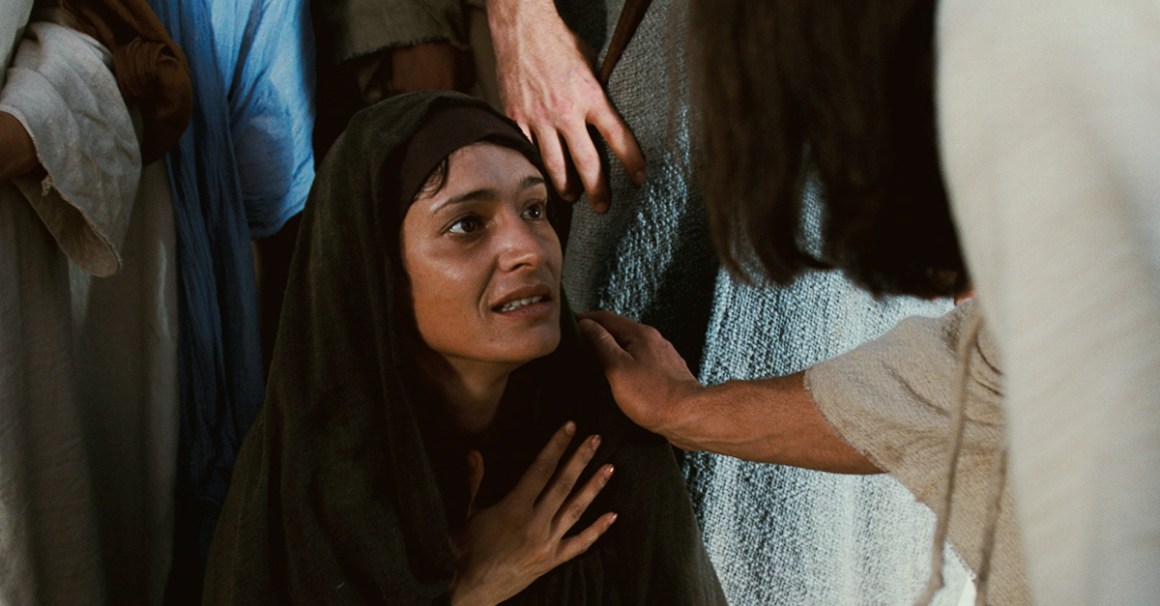
Immediately, her body is healed (Luke 8:44). But Jesus is not finished. He stops and turns around. In the middle of a pressing crowd, in the middle of urgency, in the middle of another family’s crisis, He pauses and asks, “Who touched Me?” (Luke 8:45). Jesus is not only interested in her physical healing. He is restoring her as a person. And then He says something even more radical. He calls her “Daughter” (Luke 8:48). In a culture where she had been labeled unclean, excluded and untouchable, Jesus gives her a new name: one of belonging, dignity and family.
He does not define her by her condition. He restores her identity.
Watch Jesus heal and restore the woman with the issue of blood in this powerful clip from Magdelena: Released from Shame.
Jesus does not rush urgency
While Jesus is still speaking to the woman, the news arrives, “Your daughter is dead” (Luke 8:49). Jairus had come to Jesus in desperation. His daughter was dying. Every second mattered. And yet, Jesus stopped. Not only that, but He stopped for a woman, a marginalized woman––one that the crowd likely would have dismissed.
This is more than compassion. It is culturally disruptive.
Jesus does not prioritize power over pain. He does not elevate status over suffering. He does not overlook one person’s suffering for another’s. And then as fear floods the moment, He speaks to Jarius, “Don’t be afraid; just believe” (Luke 8:50).
Before the miracle, He steadies his heart. This is what it looks like to care for those who are suffering deeply. It does not mean ignoring urgency, but it also means not letting fear dictate the moment. Jesus holds both realities at once—the woman who has waited twelve years and the father who feels he has just run out of time—and He meets each of them without rushing either.
Jesus creates safety and restores the body
When Jesus arrives at Jairus’ home, the space is filled with the noises of grief, wailing and chaos. Again, He does something unexpected. He removes the crowd (Luke 8:51). He creates a smaller, safer environment, one marked by trust, not performance. Then He moves closer. He takes the girl by the hand and says, “My child, get up” (Luke 8:54). Not loudly. Not dramatically. Just personally. And when life returns to her body, He gives a simple instruction: “Give her something to eat” (Luke 8:55).
Jesus does not just restore her life. He restores her body, her environment, her place within her family. After trauma, after fear, after loss, healing is not only spiritual. It is physical, relational and deeply human. Jesus honors that. Jesus’ care does not always look the same in every story, but His presence does.
What Jesus Shows Us About Caring for Those Who Are Suffering Deeply
In this single, intertwined story, Jesus models a way of responding to suffering that is both compassionate and intentional. Here are six trauma-informed spiritual care practices we see in Him:
1. He notices the unseen.
Jesus pays attention to those who have learned to live invisibly. Being seen and acknowledged is foundational to healing and integration, according to trauma-informed research. Jesus sees you in your quiet pain. Who in your life might be quietly hoping to be seen?
2. He restores identity before giving direction.
Jesus speaks to who you are, not just what has happened to you. The research agrees. Trauma often disrupts a person’s sense of self. Restoration begins with gaining a sense of belonging and a secure identity. Who might need to hear words of dignity and belonging from you?
3. He does not rank or rush pain.
Jesus refuses to prioritize the powerful over the marginalized. When we look at trauma-informed care, we learn that healthy care honors each person’s experience without comparison or hierarchy. This is how Jesus meets you, without comparison. Where might you be tempted to rush past someone’s pain instead of staying present?
4. He speaks peace into fear.
A calm, steady presence helps regulate distress and supports emotional stabilization, according to the research. It’s no coincidence that this is how Jesus steadies you in moments of fear. “Don’t be afraid,” Jesus says (Luke 8:50). How might you offer that same calm presence to someone who feels overwhelmed?
5. He creates safe environments for healing.
Per trauma-informed care experts, a sense of safety is a prerequisite for healing. Jesus makes space for your healing. Remember: He removes the crowd (Luke 8:51). Where could you help create a space where someone feels safe enough to be honest?
6. He cares for the body, not just the outcome.
Trauma impacts the body as well as the mind, and recovery includes physical restoration, according to the research. Jesus says, “Give her something to eat” (Luke 8:55). He tends to your whole person. Who might need simple, tangible care from you today?
Personal Invitation
I have lived inside both of these stories. I have been the girl everyone gathered around, where the crisis was visible, the prayers were urgent and the outcome felt like it mattered to everyone in the room. And I have been the woman who learned to carry pain quietly, where the suffering was harder to name and the isolation settled in slowly, almost unnoticed. What I am still learning is this: Jesus did not meet one version of me with more care than the other.
He was not more present when the room was full. He was not less attentive when the pain was hidden. He noticed. He named. He stayed. And in a world that often overlooks the suffering of women, minimizes it or moves past it too quickly, this matters: Jesus does not.
He sees. He restores dignity. He draws near. So whether your pain feels visible and overwhelming or quiet and unseen, He sees you. And as we learn to follow Him, may we begin to reflect Him: to notice the overlooked, to honor the stories of women, to slow down enough to offer presence instead of solutions. And perhaps, even more gently, to allow ourselves to be seen and restored too.
Explore more
Discover Jesus Film Project’s collection of women’s resources, which includes feature films like Magdalena, and short videos and series to help you gain a fuller understanding of how Jesus loves and cares for women. I also invite you to watch and share the Hope Collection, featuring videos meant to inspire you and point towards the greatest hope we have: Jesus.
Listen to God’s Word in the comforting and diverse voice of His daughters at www.her.BIBLE.

About the Author