
40 Evangelism Scriptures to Shape and Inspire Us


Related Posts



Subscribe To Our Weekly Newsletter
Sign up for our weekly newsletter, Jesus Film Project News, to receive encouraging stories, videos and resources in your inbox.
Updated on October 22nd, 2025 by Connie Thomson.
When I became a follower of Christ in high school, I immediately felt a strong desire to share the gospel with others. Each time I read the Bible, the message of evangelism stood out clearly and spoke deeply to me. These evangelism scriptures have stayed with over many years.
Evangelism means sharing the good news of salvation. It’s telling others that Jesus Christ is the Son of God who gave His life for our sins. Through His sacrifice, anyone who believes can have eternal life. Read this post for a detailed definition of evangelism.
While some are called to the full-time ministry of evangelism, we are all called to share the gospel. There are many types of evangelilsm and and it’s important to consider which one best fits you.
Here are 40 evangelism Bible verses that give insight into this privilege and responsibility. Some of these verses are instruction, and others can be memorized in order to inspire you to speak boldly of what God has accomplished in Christ for each of us.
1. Make God known among the nations (Psalm 105:1)
“Give praise to the Lord, proclaim His name; make known among the nations what He has done.”
This evangelism scripture is about bringing greater glory and recognition to God. Throughout the Old Testament, God sets Himself above all other gods. He creates a nation with the purpose that its people will make His name known among all nations. They are also called to share the great works He has done.
These mighty acts reach their fulfillment in the reconciliation achieved through the Cross. They are completed in His victory over death through the Resurrection. Let this verse remind us to make His name known.
2. God offers life to each of us (Proverbs 11:30)
“The fruit of the righteous is a tree of life and the one who is wise saves lives.”
When this Proverb was written, the idea of “saving lives” had more to do with delivering them from evil paths which lead to death. In light of the gospel story, it takes on a whole new significance.
Let’s consider this evangelism verse within the context of Christ’s work. The “fruit of the righteous” is quite literally a tree of life and the work of saving lives! May our lives show the fruit of the Spirit (Galatians 5:22-23) to those around us.
3. Here I am. Send me! (Isaiah 6:8)

“Then I heard the voice of the Lord saying, ‘Whom shall I send? And who will go for us?’ And I said, ‘Here am I. Send me!’”
Evangelism is about going to others. God never coerces us to serve Him, but He continually offers us a choice. The sixth chapter of Isaiah tells of the prophet having a vision of the Lord in His throne room. This sobering vision helped propel him to volunteer to share the Lord’s message.
We, too, are motivated in direct proportion to our experience with God. If we struggle to find the inspiration to share the good news, perhaps it’s time to pray for a deeper revelation of God’s glory and holiness. I hope to always keep this humble attitude of “Here I am, send me.”
4. Proclaim His name and make Him known (Isaiah 12:4)
“In that day you will say: ‘Give praise to the Lord, proclaim His name; make known among the nations what He has done, and proclaim that His name is exalted.’”
This evangelism verse reminds us that Christian witnessing is simply telling others what God has done. Much of the Book of Isaiah operates as a twofold prophecy. It has immediate importance as a prophecy about Judah, but also points at the coming Messiah who will deliver Israel—and subsequently all humanity.
Here Isaiah speaks of an evangelism that works in both timelines. Judah will be able to proclaim what the Lord has done to deliver the nation from its sin, and God’s future people will be able to exalt God’s name for what he’s done for mankind.
5. All should turn to the Lord (Isaiah 45:22)
“Turn to Me and be saved, all you ends of the earth; for I am God, and there is no other.”
Evangelism points to our only source of salvation. In the 45th chapter of Isaiah, God turns His focus on Israel’s surrounding nations who create idols to worship. Instead of worshiping idols they can carry with their hands, God encourages these nations to turn to Him, a God who can carry them in His hands.
This is an appropriate reminder to all of us who follow the Lord. There is still only one God and one salvation. There is no other. As awkward as it feels to speak this truth in a pluralistic and tolerant world, it’s no less true.
6. Hear the word God speaks (Ezekiel 3:17)
“Son of man, I have made you a watchman for the people of Israel; so hear the word I speak and give them warning from me.”
Evangelism is a divine responsibility. In this passage, God gives the prophet Ezekiel the task of being a “watchman” for Judah. The main point of this commission is that Ezekiel would deliver God’s message and warnings faithfully. A sobering element of this calling is the knowledge that when Ezekiel neglects to share the Lord’s warning for Judah’s wickedness, he will share in the responsibility.
This passage should shake us, Christ’s followers, out of our slumber. We, too, are watchmen of sorts. We have a message of salvation to deliver, and some responsibility lies on the messenger who neglects to give the message. But also—let’s take this charge on as a privilege! We have the divine opportunity to bring the message of Christ to others.
7. God will make Himself known (Ezekiel 38:23)
“And so I will show my greatness and my holiness, and I will make myself known in the sight of many nations. Then they will know that I am the Lord.”
The evangelist makes God’s greatness known. God reminds Ezekiel of the Old Testament theme that He desires Israel and the prophets to be His chosen messengers. Through them, He wants His greatness to be made known.
God still desires that He would have a people through whom the rest of the world would be blessed as they made Him known. That’s us. We are the modern-day messengers of God.
8. His name will be great among the nations (Malachi 1:11)
“’My name will be great among the nations, from where the sun rises to where it sets. In every place incense and pure offerings will be brought to me, because my name will be great among the nations,’ says the Lord Almighty”
We share God’s goodness with all of creation. The Old Testament closes with Malachi reiterating God’s desire for fame among the nations.
The picture of God’s goodness being known everywhere the sun touches is poignant and important. We, too, bear a responsibility to share God’s goodness to every tribe, tongue and nation—everywhere the sun touches.
9. Let your light shine to everyone (Matthew 5:15-16)
“Neither do people light a lamp and put it under a bowl. Instead they put it on its stand, and it gives light to everyone in the house. In the same way, let your light shine before others, that they may see your good deeds and glorify your Father in heaven.”
Our goodness is a form of evangelism. Why don’t people light a lamp and put it under a bowl? Because it’s wasted effort. If you light a lamp, you’re bringing light to your home.
Here Jesus reminds us that He doesn’t want to waste His efforts either. Our lamps have been lit with the intention that we would give light to others as well.
It’s important to note that, in this instance, our good deeds are the light He is talking about. When we do good works, we give credence to the gospel. It’s not just the evil that we do that works against the gospel, but also our unwillingness to do good.
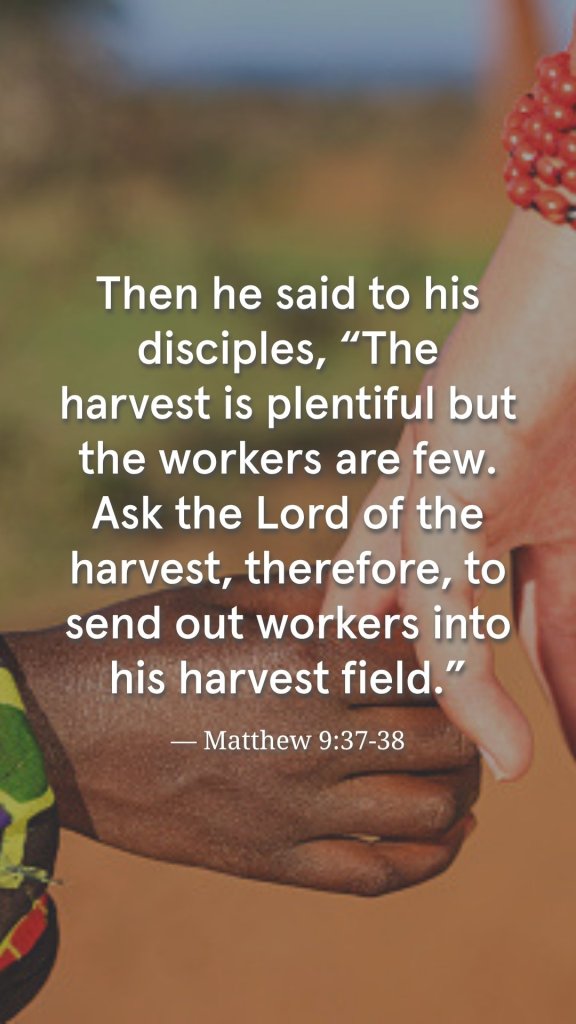
10. The harvest is plentiful (Matthew 9:37-38)
Prayer is an important part of evangelism. In a world full of hungry people, is there a more heartbreaking picture than ripe fruit rotting on the vine because there just aren’t enough harvesters to bring it in? The same is true in a world full of pain and heartbreak. The gospel desperately needs harvesters to share the message with those whose hearts are ripe to receive the good news.
The Lord has given us the responsibility to make evangelism a priority in the church. This is more than rushing around telling people about Jesus. It’s also about praying that the Spirit will move in others to feel the importance of joining the work of evangelism.
11. Jesus offers rest (Matthew 11:28)
“Come to me, all you who are weary and burdened, and I will give you rest”
Evangelism promises immediate results. If we simply share the benefits of the gospel as something that saves people after they die, we’re doing it a disservice. The gospel has immediate benefits to those who are weary and broken.
We need to make sure that we are communicating the supernatural strength available to those who submit to the Lord. Jesus had a heart to reach the outcasts of his culture. He offered them rest.
12. Go and make disciples (Matthew 28:19-20)
“Therefore go and make disciples of all nations, baptizing them in the name of the Father and of the Son and of the Holy Spirit, and teaching them to obey everything I have commanded you. And surely I am with you always, to the very end of the age”
This is definitely everyone’s favorite evangelism scripture. It’s referred to as the Great Commission. When we read this passage, we need to read it as Jesus’ marching orders. There isn’t a person who has made the decision to follow Jesus who is exempt from this commission.
This is about more than just getting someone to pray the “sinner’s prayer.” It’s about equipping them to grow in grace and truth—and be people who take up this mission themselves.
Read more about what the Great Commission is here.
13. Whoever believes will be saved (Mark 16:16)
“Whoever believes and is baptized will be saved, but whoever does not believe will be condemned.”
Evangelism is important. Until we begin to internalize what’s at stake in evangelism, we will struggle to rightly prioritize it. We have the ability to help move someone from a condemned state to a redeemed state by sharing the forgiveness of Christ.

14. Whoever acknowledges Christ will be acknowledged (Luke 12:8)
“I tell you, whoever publicly acknowledges me before others, the Son of Man will also acknowledge before the angels of God.”
Evangelism is for Christ’s pleasure. Imagine Christ publicly acknowledging you among the heavenly host for your willingness to identify yourself with Him. I don’t think Jesus will neglect to share His pleasure for every time we’ve communicated the good news of the gospel to another.
15. The Holy Spirit will give you the words (Luke 12:11-12)
“When you are brought before synagogues, rulers and authorities, do not worry about how you will defend yourselves or what you will say, for the Holy Spirit will teach you at that time what you should say.”
Evangelism isn’t about having all the right arguments. Jesus is telling the disciples that a time is coming when the cost of sharing the gospel will be high. He encourages them not to be concerned about what they will say when they’re dragged before those in authority, The Holy Spirit will move on their behalf.
Sometimes we’re so worried about having the right answer to every question that we neglect to open our mouths. It’s helpful to remember that the Holy Spirit is there helping us to communicate. He is also working in the hearts of those with whom we’re sharing.
16. God so loved the world that He gave (John 3:16-17)
“For God so loved the world that He gave His one and only Son, that whoever believes in Him shall not perish but have eternal life. For God did not send His Son into the world to condemn the world, but to save the world through Him.”
Evangelism is good news. We’re often so focused on what happens to those who deny Christ, that we forget that the gospel is good news. We’re not sharing a message of condemnation, but one of a God who loves humanity. He was willing to make the ultimate sacrifice so that we could be reconciled to Him.
17. They will know you by your love (John 13:35)
“By this everyone will know that you are my disciples, if you love one another.”
Our behavior is a form of evangelism. Many philosophies and religions compete for people’s attention. Ultimately, there must be something that distinguishes one from the rest and proves its truth and worth.
We’d like to think that the gospel is confirmed by our lofty arguments. The truth is that it’s the gospel’s fruit that proves the gospel’s message. There is no greater fruit than the love God’s people have for each other.
It’s so important that we realize that the opposite is also true. Our inability to love and affirm one another undermines the gospel’s message of reconciliation.
We are therefore Christ’s ambassadors, as though God were making His appeal through us.
18. Jesus is the Way, the Truth, and the Life (John 14:6)
“Jesus answered, ‘I am the way and the truth and the life. No one comes to the Father except through me.’”
Jesus is the doorway to God. This evangelism Bible verse is our reminder that there is no other way to be reconciled to God but through Jesus Christ.
19. Disciples will bear much fruit (John 15:8)
“This is to my Father’s glory, that you bear much fruit, showing yourselves to be my disciples”
Disciples bear fruit. In keeping with John 13:35 (#17), it’s imperative that we accept that our behavior and our fruit is a form of proof that reinforces our evangelism.
The word “holiness” literally means “set apart.” We are set apart for God’s work, and this will set us apart in our culture.
People will judge our words by our works. We need to have evidence in our lives that communicates the truth of the gospel we preach.
20. You will receive power from the Holy Spirit (Acts 1:8)
“But you will receive power when the Holy Spirit comes on you; and you will be my witnesses in Jerusalem, and in all Judea and Samaria, and to the ends of the earth”
Our evangelism is empowered. Jesus speaks in future tense of the empowerment that will come through the Holy Spirit. This power will give potency to the disciple’s message as they take the gospel to the ends of the earth.
This power that was to be given via the Holy Spirit came soon afterward, and is available to all of us who seek to be obedient to our calling. We have the power we need to fulfill our high calling!
This verse also reminds us that we are called to share to everyone, not just those right next to us. For more learning about the Book of Acts, read this.
21. He has made us a light (Acts 13:47)
“For this is what the Lord has commanded us: ‘I have made you a light for the Gentiles, that you may bring salvation to the ends of the earth’”
The church is the light of the world. To the first-century Jew, the idea that God’s salvation would extend beyond Israel was completely foreign. Yet God had always told Israel that through them all the nations would be blessed.
All of us who follow Christ are part of His goal of redeeming the whole world to Himself. We are the light of the world. There is no plan B.
22. Our aim is to complete the task (Acts 20:24)
“However, I consider my life worth nothing to me; my only aim is to finish the race and complete the task the Lord Jesus has given me—the task of testifying to the good news of God’s grace.”
We must finish our task of evangelism. If you’re looking for inspiration, tape up this evangelism scripture all around your home. Paul’s single-minded focus to fulfill his responsibility of sharing the gospel as widely as possible should energize us all.
23. Not ashamed of the gospel (Romans 1:16)
“For I am not ashamed of the gospel, because it is the power of God that brings salvation to everyone who believes: first to the Jew, then to the Gentile.”
We share God’s power through evangelism. Our willingness to share the gospel puts us at the mercy of those who may scoff at our devotion. It only takes a couple times of being laughed at, ridiculed or treated roughly for sharing the gospel before you’re tempted to downplay your faith.
Don’t be afraid or ashamed. The gospel is the power of God!
24. The gift of God is eternal life (Romans 6:23)
“For the wages of sin is death, but the gift of God is eternal life in Christ Jesus our Lord.”
Evangelism helps God share His gift of life. Apart from the gospel, we would all receive our wages as workers of inequity. Christ’s gospel has the power to swap out those wages for a free gift of eternal life!
25. How can they preach unless they are sent? (Romans 10:14-15)
“How, then, can they call on the One they have not believed in? And how can they believe in the One of whom they have not heard? And how can they hear without someone preaching to them? And how can anyone preach unless they are sent? As it is written: ‘How beautiful are the feet of those who bring good news!’”
Evangelism is a necessary part of the salvation process. How will anyone hear about Christ unless they are told?
God has always wanted a people who labor beside Him. It is entirely possible that God could magically place the message of the gospel in the hearts of every person, but He doesn’t. Why? Because He wants us as the church, to play a part.
26. Proclaim the testimony about God (1 Corinthians 2:1-2)
“And so it was with me, brothers and sisters. When I came to you, I did not come with eloquence or human wisdom as I proclaimed to you the testimony about God. For I resolved to know nothing while I was with you except Jesus Christ and him crucified.”
Evangelism isn’t about fancy arguments. The New Testament is full of Paul’s thoughtful defense of Christianity. It is encouraging to see that his approach to evangelism was not focused on creating the most eloquent or flawless arguments. He came with a simple message of Christ and His sacrifice.
The best evangelists aren’t the greatest orators; they’re the ones who are single-minded in their desire to share what God has done.
27. God makes the seed grow (1 Corinthians 3:6-9)
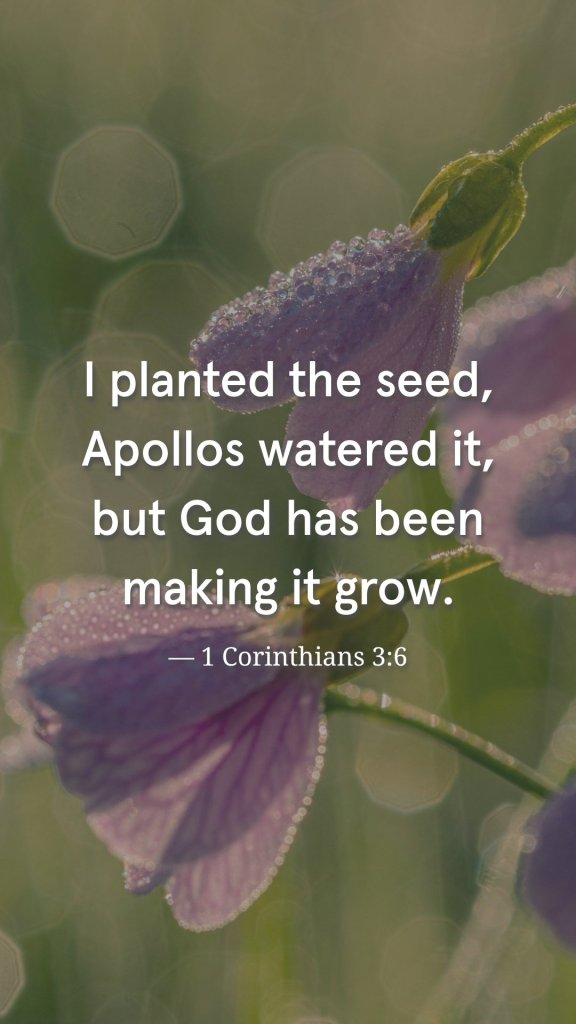
Evangelism isn’t always about securing a commitment. We share God’s message, but God causes it to take root and grow into faith. And even if we don’t always get to see the fruit, we can take solace that we are playing an important role in the harvest.
I know that for me, a woman named Stephanie shared the gospel with me the first time. I prayed with her to ask Christ into my life. Then I went away from my walk with God. When I came back into a community of believers, it was another woman named Barb who helped me to grow into a deep understanding of who Jesus is and who he wants me to be.
Stephanie planted the seed, Barb watered it. But God made it grow.
28. Become all things to all people (1 Corinthians 9:22-23)
“I have become all things to all people so that by all possible means I might save some. I do all this for the sake of the gospel, that I may share in its blessings.”
Empathy has an important role in evangelism. God’s Word manifests itself differently in each of us. So our goal isn’t to get others to conform to our cultural standards as proof of their faith. Rather, we are sensitive to their traditions and experiences so that we don’t insult or confuse them before we’ve had a chance to introduce them to Jesus.
Relating to others is very helpful when it comes to personal evangelism. And meeting people through felt needs is imperative for evangelistic preaching. Those are two examples of becoming all things to all people, as we try to relate the gospel to those around us.
29. Follow God’s lead (1 Corinthians 16:7-9)
“For I do not want to see you now and make only a passing visit; I hope to spend some time with you, if the Lord permits. But I will stay on at Ephesus until Pentecost, because a great door for effective work has opened to me.”
This evangelism verse reminds us to be open to the Spirit of God within us. It was Paul’s desire to invest some quality time with the church at Corinth and with the issues going on there, it’s obvious they needed it. Yet, Paul was aware that the Spirit was making opportunities to share the gospel in Ephesus, and following the Lord’s movement is Paul’s priority.
It’s important to remember that we will be pulled in many directions. We must follow the Lord’s prompting and not view opposition as a reason to give up. I think of this as being “interruptable.” God’s Spirit can nudge us in our conscience to do something other than what we had planned.
30. We are Christ’s ambassadors (2 Corinthians 5:20)
“We are therefore Christ’s ambassadors, as though God were making His appeal through us. We implore you on Christ’s behalf: Be reconciled to God.”
God makes His appeal through us. It’s God’s desire that the world would submit to be reconciled to him, and he is making that appeal through us, the church. We are the diplomats that God has sent to represent him in this foreign territory.
31. God calls believers to certain places (Galatians 2:7-9)
“They recognized that I had been entrusted with the task of preaching the gospel to the uncircumcised, just as Peter had been to the circumcised. For God, who was at work in Peter as an apostle to the circumcised, was also at work in me as an apostle to the Gentiles. James, Cephas and John, those esteemed as pillars, gave me and Barnabas the right hand of fellowship when they recognized the grace given to me. They agreed that we should go to the Gentiles, and they to the circumcised.”
Follow your prompting, let others follow theirs. It’s easy to feel God is prompting you toward a specific work and think His prompting is universal. This was a problem that was brewing in the early church. Peter felt called to witness to the Jews and struggled with Paul’s contrary calling to preach to the Gentiles. In the end, don’t be dissuaded from reaching the people you feel called and empowered to reach.
So do not be ashamed of the testimony about our Lord
32. It is by grace that we are saved (Ephesians 2:8-9)
“For it is by grace you have been saved, through faith-and this is not from yourselves, it is the gift of God-not by works, so that no one can boast”
Evangelism is always about God’s work. We do well to remember that salvation is not something we earned by the work we’ve done.
In the same way, the successes we see in evangelism are a response to God’s grace at work in someone’s life, and not because of our works, so we still can’t boast!
33. Present everyone fully mature in Christ (Colossians 1:28-29)
“He is the one we proclaim, admonishing and teaching everyone with all wisdom, so that we may present everyone fully mature in Christ. To this end I strenuously contend with all the energy Christ so powerfully works in me.”
Salvation isn’t the goal of evangelism; discipleship is. Paul was all about sharing the gospel, but he never saw that as his only responsibility.
He worked tirelessly to ensure that new believers could grow into maturity. This is in keeping with Christ’s commission that we not only share the good news, but that we teach them to do everything that Christ commanded.
34. Devote yourselves to prayer (Colossians 4:2-6)
“Devote yourselves to prayer, being watchful and thankful. And pray for us, too, that God may open a door for our message, so that we may proclaim the mystery of Christ, for which I am in chains. Pray that I may proclaim it clearly, as I should. Be wise in the way you act toward outsiders; make the most of every opportunity. Let your conversation be always full of grace, seasoned with salt, so that you may know how to answer everyone.”
This evangelism scripture is like an evangelist’s rule book. In these four verses, Paul hits on the six elements of responsible evangelism:
- Pray regularly for opportunities to share the gospel.
If you’re serious about sharing the good news, you will be asking God to give you more and more opportunities. - Be watching and thankful.
Since you’re praying for opportunities, you’re going to be on the lookout for them, thankful when they occur. - Pray for opportunities for others to share the gospel clearly.
You’ll also pray for others to have opportunities to share the gospel, and that they would do so with power and authority. - Be wise about how you treat outsiders.
You’ll learn to think of every conversation as an important part of your evangelism. It’s not that you’re always sharing the gospel; it’s that you don’t want to do anything that undermines you before you do. - Make the most of every opportunity.
Making the most of your opportunities requires a lot of vigilance and grit. You need to be on guard to recognize your opportunities, and you need to have the resolve to take advantage of those opportunities when they surface. - Ensure that your conversations are full of grace.
It’s so important that we recognize that our conversations reflect the gospel-even when we’re not talking about the gospel.
35. The gospel comes with power (1 Thessalonians 1:4-5)
“For we know, brothers and sisters loved by God, that he has chosen you, because our gospel came to you not simply with words but also with power, with the Holy Spirit and deep conviction. You know how we lived among you for your sake.”
Your life gives your evangelism traction. Fight the temptation to bury yourself in books to empower evangelism. Having a good argument isn’t the only facet of sharing the gospel.
We must come in the strength that comes from our communion with Christ. We should carry a deep conviction, knowing that the Lord is already working in this person’s life. Our own way of living should affirm the truth of the gospel we share.
36. Don’t be ashamed (2 Timothy 1:8)
“So do not be ashamed of the testimony about our Lord or of me his prisoner. Rather, join with me in suffering for the gospel, by the power of God.”
Evangelists will face opposition. Paul reminds Timothy that the opposition to the gospel and his imprisonment is no reason to be ashamed. Resistance is to be expected and even if the culture views imprisonment with shame, Paul doesn’t want Timothy to shy away from the potential price of sharing the good news.
37. Present yourself to God (2 Timothy 2:15)
“Do your best to present yourself to God as one approved, a worker who does not need to be ashamed and who correctly handles the word of truth.”

Evangelists invest in their own discipleship. The believer’s process of maturity is ongoing. We should continually learning as much as we can. Then, when the opportunity arises, we can handle God’s Word with confidence and power.
38. Do the work of an evangelist (2 Timothy 4:5)
“But you, keep your head in all situations, endure hardship, do the work of an evangelist, discharge all the duties of your ministry.”
Do the work of an evangelist. Paul finishes his second letter to Timothy with this commission. With all the work that Timothy is called to as a young pastor, Paul wants to ensure that he doesn’t neglect the work of evangelism.
39. Always be prepared (1 Peter 3:15)
“But in your hearts revere Christ as Lord. Always be prepared to give an answer to everyone who asks you to give the reason for the hope that you have. But do this with gentleness and respect.”
“Always be prepared.” I know there are times in my life when I have been confronted with an opportunity to share my faith, and I wasn’t prepared. Maybe fear overcame me. Maybe I didn’t know the right answer to someone’s question. But this verse reminds us to always be prepared. That is something I strive to do.
This evangelism scripture from Peter also reveals how simple sharing your faith can be. It isn’t about arguing someone into submission. It’s about gently and respectfully sharing why you have your hope is in Christ. It doesn’t need to be contentious or difficult. It should be natural and sincere.
40. The Lord doesn’t want anyone to perish (2 Peter 3:9)
“The Lord is not slow in keeping his promise, as some understand slowness. Instead he is patient with you, not wanting anyone to perish, but everyone to come to repentance.”
Evangelism fulfills God’s desire to reconcile with everyone. Even Peter was impatient for the Lord’s return, and that was a couple of thousand years ago. But the Lord is still withholding judgment because he wants everyone to have an opportunity to enter into relationship with Him.
Evangelism is not only the way that we take the gospel to every living creature. It is the way we help fulfill God’s desire.
Conclusion
I hope these Bible verses on evangelism have reminded you and encouraged you. God has a plan for this world to be close to Him. We get to be a part of his salvation plan. To learn more about evangelism, you can read about
- Personal Evangelism
- Church Evangelism
- Cross-cultural Evangelism
- Evangelistic Preaching
- Street Evangelism
To continue hearing from Jesus Film Project, please subscribe to our newsletter.
*All Scripture is taken from the New International Version translation.
More Scripture Verse Articles
If you’re looking for more themed Bible verse lists, check out these additional blogs:

About the Author