
From Wall Street to Street Preaching: A Journey of Boldness and Faith

Related Posts


Subscribe To Our Weekly Newsletter
Sign up for our weekly newsletter, Jesus Film Project News, to receive encouraging stories, videos and resources in your inbox.
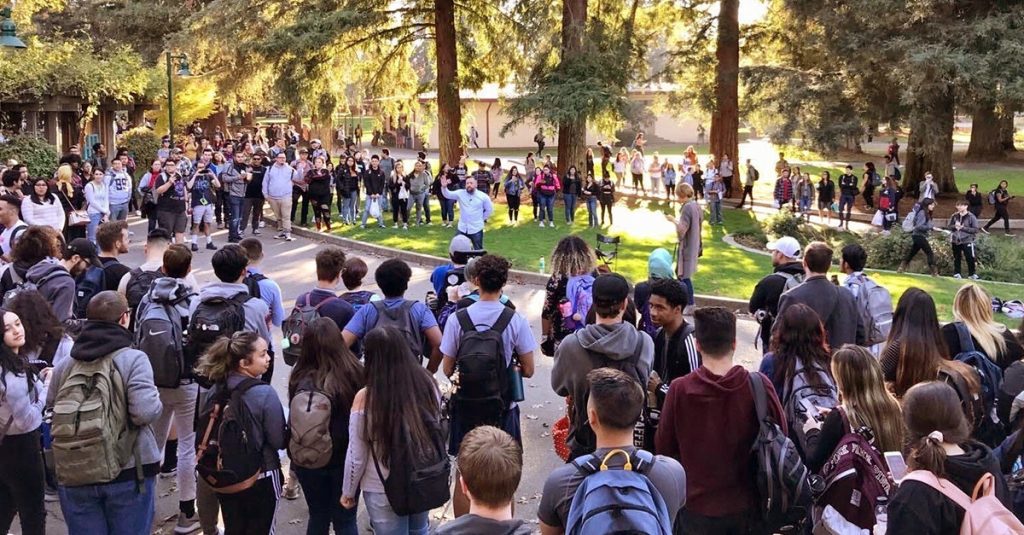
I first met campus preacher Keith Darrell, back at Miami University in Oxford, Ohio. We were both involved with a college ministry called CruⓇ.
Keith was sharp, witty and clearly destined for a successful life. He proved it in New York City, where he climbed the finance ladder for five years. He wore tailored suits and had a comfortable salary.
But here’s the unexpected turn: Keith traded Wall Street for sidewalks, swapping stock reports for sermons and a steady income for the challenge of unpredictable campus crowds. Only Keith could make that kind of career move look normal!
That leap of faith turned Keith into a street preacher who uses his voice to reach students who might never walk into a church.
What is Street Preaching?
Street preaching is telling people about Jesus out in public. Some call it open-air preaching. This can happen on a street corner, in a park or on a busy campus.
The goal of street preaching is simple: share the love of Jesus with people who might never hear it another way. Street preaching is a little different than street evangelism, because it is more focused on gathering a crowd, as opposed to talking one-on-one to individuals on the street.
Keith Darrell said that he knows he is planting seeds in hearts (1 Corinthians 3:6), even when he doesn’t see people give their lives to Jesus.
History of Street Preaching
Evangelism means telling others about the gospel of Christ (read more on the meaning of evangelism here). There are different types of evangelism that each of us engages in.
Many Bible verses on evangelism encourage us to be active in sharing our faith. Here we are looking at street preaching in particular.
Street preaching is not new. The Bible tells us how people like Peter, Paul and John spoke in public.
- Peter in Jerusalem (Acts 2:14–41)
On the day of Pentecost, Peter preached to the crowd in Jerusalem. Thousands heard the message in the open air. About 3,000 people believed and were baptized. - Paul in Athens (Acts 17:16–34)
Paul preached in the marketplace and later at the Areopagus. He told people about the “unknown God” and pointed them to Jesus. He used the setting and culture around him to explain the gospel. - John the Baptist (Matthew 3:1–12)
John preached in the wilderness, calling people to repent and prepare for the coming of Jesus. John spoke outdoors where crowds gathered to hear him, and many were baptized.
There have been numerous street preachers throughout the history of the church.
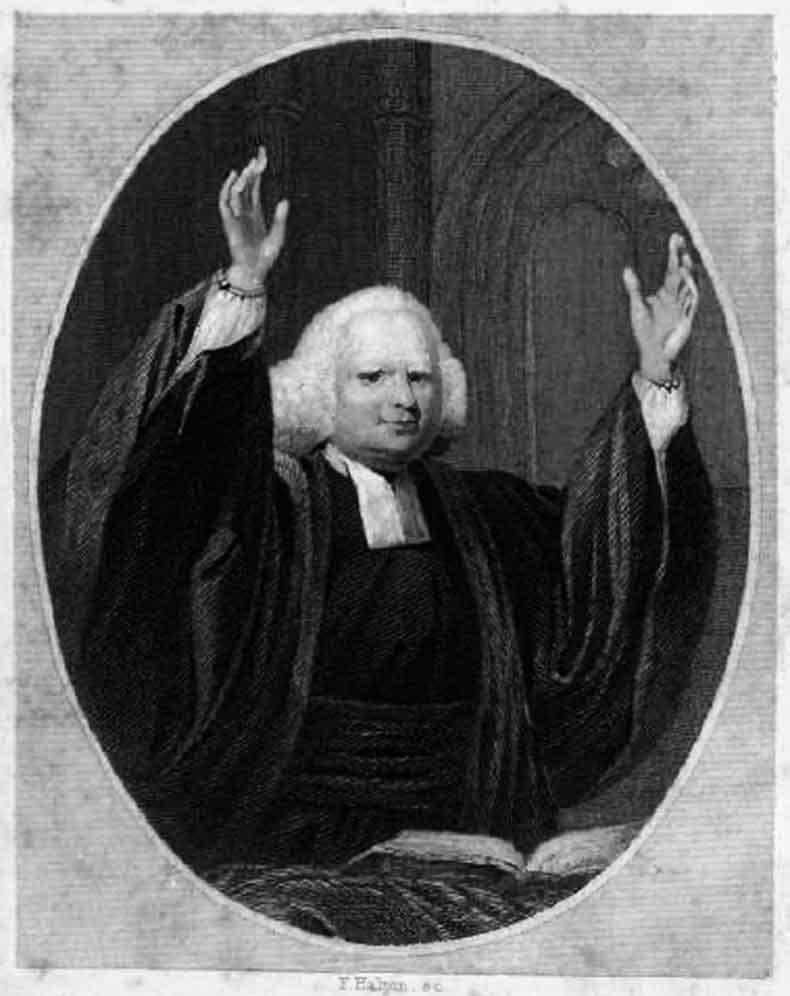
- George Whitefield (1714–1770) was an English Anglican cleric and evangelist. He was known for preaching in the streets to huge crowds during the Great Awakening. You can find George Whitefield’s biography on Amazon. You can read more about George Whitefield and his quotes on evangelism.
- John Wesley (1703–1791) founded the Methodist denomination of Christianity. He preached in fields and open-air gatherings when many churches closed their pulpits to him.
- William Booth (1829–1912) founded The Salvation Army. He took preaching into the streets of London’s East End to reach the poor and marginalized.
- Ray Comfort (1949– present) founded Living Waters Ministry. He is a New Zealand-born Christian evangelist and author, known for preaching in the streets and work in producing gospel tracts and resources.
Today, Christians still engage in street preaching. And it can still change lives.
Keith Darrell has been preaching since 2000 and full-time since 2010. What keeps him going? “Prayer,” he said. “I ask God to provide, and He does. I ask God to change hearts, and I see it happen. That’s what fuels me!”
An Interview With a Street Preacher
I got the chance to speak with Keith Darrell who is a friend from my college days. His story shows us both the challenges and the joy of this work.
Keith didn’t start as a preacher. After seminary, he moved to New York City in 2005 to work in finance. During that time, his main job was working in investments. He would take a day off to preach in the streets of New York City from time to time.
By 2009, he felt God calling him into full-time open-air preaching. “I couldn’t ignore it,” he said.
Within a period of two months, seven friends and mentors confirmed his calling. So he left his finance job and went into open-air preaching ministry full-time.
Keith first learned about street preaching in college. He remembers watching a bold preacher named Jed (George Smock, Jr.) who drew large crowds.
At first, Keith thought he could do it differently than Jed—more positively. He would point to a loving God in his sermons instead of scaring people away from the gates of hell.
Over time, he found a balance between the two messages. Now he engages students with humor, listens to their difficult questions and always points them back to the gospel.

“I usually start with Psalm 24,” he shared. “It says the earth belongs to God. Right away, students push back. But that opens the door for real conversations. People want to debate. They want answers. I try to meet them there.”
Keith finds a public space on a college campus and begins by reading the full passage loudly to anyone who will gather to listen.
He explained that his style is not about yelling, but about dialogue. “Sometimes I let the crowd guide where the talk goes. Students often ask about sex, relationships or science. No matter what, I try to connect it back to Jesus.”
For Keith, success as a street preacher is not just drawing a large crowd. It’s when he witnesses students soften toward the gospel.
“Some days I whiff (fail to get a response),” he laughed. “But other days, someone will stick around afterward and say, ‘Tell me more about Jesus.’ Those moments keep me going.”
Street Preaching Verses
Keith’s story shows how powerful street preaching can be in real life. He is not alone in sharing Jesus’ message publicly. The Bible encourages believers to preach the gospel everywhere.
Let’s look at some key Bible verses that talk about street preaching:
“Shout it aloud, do not hold back. Raise your voice like a trumpet. Declare to my people their rebellion and to the descendants of Jacob their sins.” — Isaiah 58:1, New International Version
“The Lord said to me, Proclaim all these words in the towns of Judah and in the streets of Jerusalem. …” — Jeremiah 11:6, NIV
“Go out to the roads and country lanes and compel them to come in, so that my house will be full.” — Luke 14:23, NIV
“Go, stand in the temple courts,” he said, “and tell the people all about this new life.”
“Go, stand in the temple courts,” he said, “and tell the people all about this new life.” — Acts 5:20, NIV
“So he reasoned in the synagogue with both Jews and God-fearing Greeks, as well as in the marketplace day by day with those who happened to be there.” — Acts 17:17, NIV
“You know that I have not hesitated to preach anything that would be helpful to you but have taught you publicly and from house to house.” — Acts 20:20, NIV
How to Street Preach
Charles Spurgeon (1834–1892) was an influential Baptist preacher known for his powerful sermons and devotion to spreading the gospel. His advice on street preaching is worth following because he combined deep biblical insight with practical methods to reach people with the gospel. You can read Spurgeon’s instruction on street preaching here.
While things have changed over the years, many of his suggestions still apply. Here are some tips on how to street preach today:
- Start with a clear message. Share who Jesus is and why He matters.
- Keep it simple. Use easy words and tell stories from the Bible.
- Ask questions. This invites people into a conversation.
- Prepare for hecklers. Expect questions or teasing, and be ready to turn it into a chance to discuss Jesus.
- Be kind. Some people won’t agree. Respond with gentleness.
- Use resources. Tools like gospel tracts can be available for listeners to take with them.
The Billy Graham Association offers global online training for believers to learn how to confidently share Christ. The modules in this course cover application, biblical principles and outreach.
Keith said that when he started preaching, it took him six weeks to build and keep a crowd of people. He mentioned that at first, it felt like being a new stand-up comic, where no one listens to you, you can’t get a laugh and you don’t know what you’re doing.
But after preaching for a while, he came up with some good material to keep conversations going. Keith said, “I’m responsible for everything that comes out of my mouth.” Because of this, he maintains a laser focus on the gospel.
While students try to get him off-topic, or sidetrack the conversation, he always connects his content back to the person of Jesus Christ.
Keith added, “I don’t have all the answers. Sometimes I’ll say, ‘That’s not my area,’ or I’ll go study and come back with a better response. It’s okay to keep learning.”
Challenges in Street Preaching
Street preaching is powerful, but it’s not always easy. Many street preachers deliver “hell and damnation” messages—a sermon style that emphasizes judgment, sin and the consequences of rejecting God’s message. Some people view these preachers as rude or too loud. This preconceived idea is a challenge. That’s why respect for the listeners is key.
Engaging people with humility and a willingness to understand different perspectives can help break down these barriers. When preachers focus on respectful dialogue rather than aggressive messages, they create a safe space where their message is more likely to be heard and considered, rather than immediately dismissed because of personal biases.
There may be those in the audience who have genuine questions about faith in Christ. Some of these can be answered through apologetics in evangelism.
There are also rules. Some cities require permits for public speaking. It’s wise to look into the laws of the town or community you’re in before you begin preaching. Safety is important too—it’s a good idea to preach with a friend and be aware of your surroundings.
Of course, hecklers and haters can be a challenge in street preaching. Many listeners want to argue. Keith said he uses these people’s rebuttals in his talks.
Handling hecklers
One student named Shawn in Idaho was an avid opponent of Keith’s talks. He consistently interrupted and argued with Keith on campus about the existence of Jesus. Keith would provide detailed reasoning for the existence of Jesus. This not only ministered to the doubter, but to the other listeners.
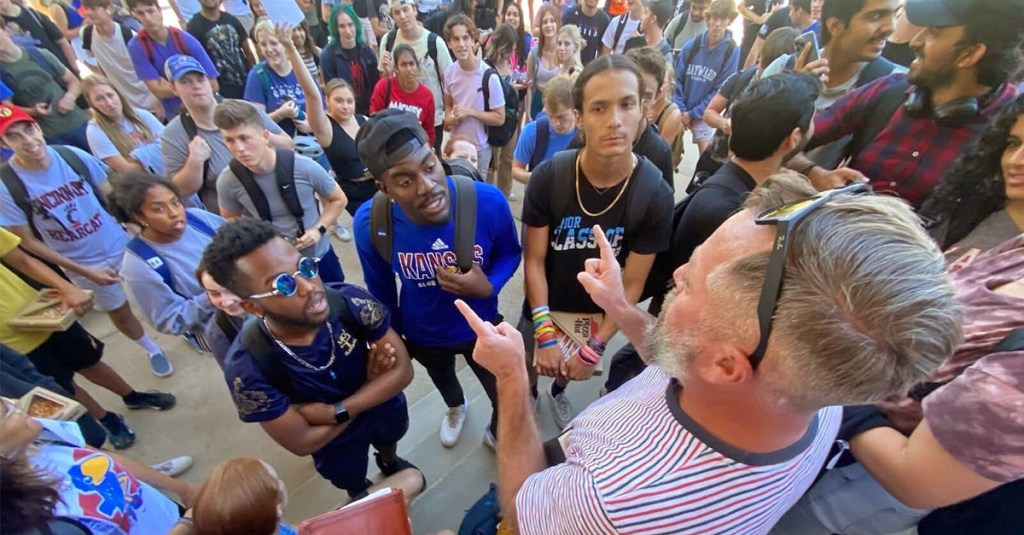
Keith said one time at a campus in Oregon there was a disruptive listener that he went back and forth with multiple times. Another guy in the crowd asked, “Can you say anything about that guy?” Keith replied, “I’ll say he’s persistent! That’s a good quality to have.” Again, his reaction to this critic showed patience, grace and kindness in the midst of abrupt interruptions.
He also mentioned that humor can help: “If people laugh, they relax. But you can’t always control how they hear you. I just try to keep it light and focus on Jesus.”
Is Street Preaching Effective?
Keith has seen God work in the lives of students through being a street preacher. What are some success markers? He shared a few with me.
- Remember Shawn the heckler? Shawn hated Keith and the things he preached. He seemed to find amusement in planning to disrupt and create chaos. Keith challenged Shawn to go and read Bart Ehrman on the existence of Jesus.
Four years later, Keith was at a church in Idaho and heard Shawn’s voice shouting, “Keith? Keith Darrell? I used to argue with you on campus! Six months ago, I became a believer.” Keith could barely believe this! Shawn had studied and learned that Jesus was real, and had put his faith in Christ.
- At the University of Oregon, a student said, “I’ve never set foot in a church before. My parents are agnostic. But I just thought you were so funny out there!” Keith took the student out for dinner and more discussion.
Keith’s humor opened the door to deeper conversation with that student who probably would never have encountered the gospel otherwise.
- Keith has received emails from students— one came two years after their meeting and another came five years after. They shared that they have now come to faith in Christ, and it all started with the one time they saw Keith preach on their campus.
- Keith brings a chair with him to campus. After preaching for four hours, he will sit on the chair with the students who remain to ask questions.
He can talk with these interested students more personally and quietly on a smaller scale. These are usually people whose hearts have become softened to the gospel and who genuinely want to engage further.
Why Street Preaching Still Matters
Street preaching is direct. It meets people where they are—busy, distracted, sometimes curious. It has always been part of the Christian story. From Peter in Jerusalem to Keith Darrell on a college campus, God uses open-air preaching to reach hearts. While some people will be reached by church-based evangelism, others will stay out of churches on purpose.
Keith explains: “I can’t imagine going back to a normal job. I’ve seen too many lives change. This is what I was made for.”
From Peter in Jerusalem to Keith Darrell on a college campus, God uses open-air preaching to reach hearts.
Street preaching is not about shouting. It’s about loving people enough to tell them about Jesus.
You may not feel called to preach on the streets yourself, and that’s okay. The act of sharing one’s faith or beliefs can take many forms, and not everyone is suited to this particular method of evangelism.
1 Corinthians 12:4-11 explains that God has gifted us all differently. There are certain people who God has called to preach publicly. Others, he asks us all to engage in personal evangelism. You can also make a difference by supporting and sponsoring those who are sharing Jesus publicly. Visit Keith Darrell’s website to find out more about how you can support his ministry.

About the Author