
Learn from Philip the Evangelist and His Everyday Boldness

Related Posts



Subscribe To Our Weekly Newsletter
Sign up for our weekly newsletter, Jesus Film Project News, to receive encouraging stories, videos and resources in your inbox.
Updated on March 6, 2026 by Connie Thomson.
There have been a few moments in my life when evangelism wasn’t difficult.
In college I won a free trip to an all-inclusive resort in Jamaica. I was sitting at the bar one afternoon there, and a man came and sat next to me. He asked, “What are you drinking?” When I replied, “A virgin banana daiquiri,” he was surprised. He said, “We are at an all-inclusive resort. Why would you be drinking a virgin drink?!”
His response to my choice opened a door for me to share my Christian faith. And though it doesn’t always happen like that, from time to time, God opens doors for you to personally evangelize.
This reminds me of the story in the Bible of Philip the evangelist and the Ethiopian eunuch. To me, it seems like God put an interested seeker right in Philip’s path.
In his story, we meet a Spirit-led follower of Jesus, Philip, who carried the good news beyond familiar borders. He preached clearly. He served compassionately. He followed the Holy Spirit with courage.
As we trace his story, we see the church moving outward with bold faith and practical wisdom. We also find a process for sharing Christ that is simple, biblical and effective. If you’ve ever wondered how to step into everyday conversations about Jesus with confidence, Philip the evangelist in the Bible gives us a great path forward.
Life and Ministry of Philip the Evangelist
Philip the evangelist, whom we meet in the Book of Acts, isn’t the same Philip we met in John 6:5-15. There are two different Philips.
We first see this Philip the evangelist in the Book of Acts when the church in Jerusalem is growing quickly and needs trustworthy leaders. In Acts 6, the apostles appoint seven servants to ensure Greek-speaking widows are not overlooked in the daily distribution of food.
The qualifications are clear: have a good reputation and be full of wisdom and the power of the Holy Spirit. Philip meets the criteria. The church’s choice shows their confidence in his character and spiritual maturity. When we picture Philip in the Bible, we see a man willing to serve tables before he ever steps onto a public platform. (Acts 6:2-3)
His service soon expands. After Stephen’s death, persecution scatters believers. Evangelist Philip heads to Samaria, where he proclaims Christ. God confirms the message with signs. Many believe and are baptized. The city is filled with joy. (Acts 8:4-8)
In this moment, we see a key shift: the gospel moves across a deep social divide. Samaria was a community that was long estranged from Jerusalem culturally. Philip shows us that Jesus’ mission crosses barriers that people put up.
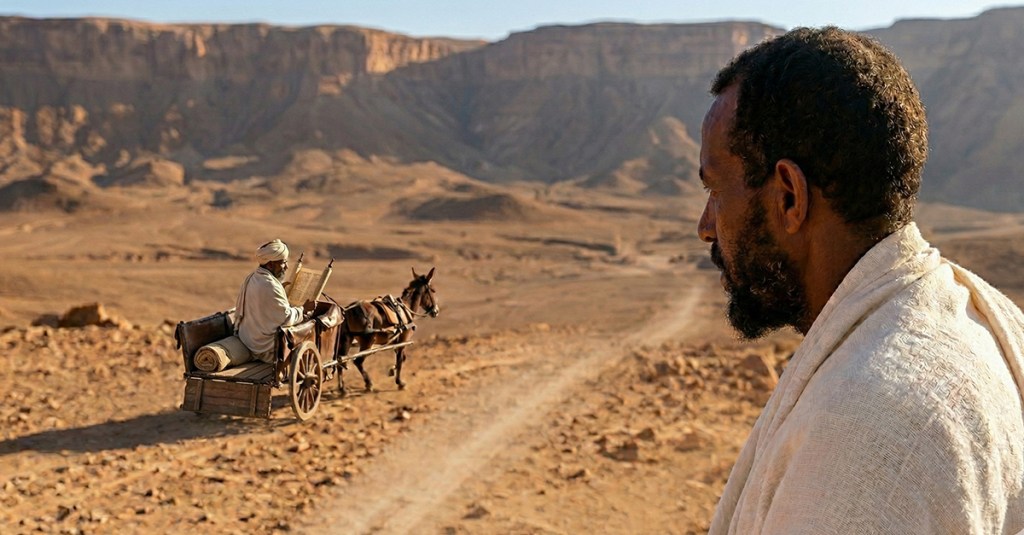
Then God redirects him again. An angel instructs him to take the desert road from Jerusalem to Gaza. He goes. The road seems empty, but God has prepared a divine appointment. Philip meets an Ethiopian official—an influential traveler reading Isaiah and searching for understanding.
Philip listens, asks a thoughtful question and begins with Scripture. He explains how Jesus fulfills the prophecy of the suffering servant. The official believes, sees water and asks to be baptized. Philip baptizes him immediately.
The Spirit then carries Philip away, and he continues preaching from town to town. (Acts 8:26-40)
Wait … what? Can we just pause here for a second? “The Spirit carries Philip away”? I’m sorry—he what? One minute Philip is standing there beside the water, and the next minute he’s gone? Just like that?
Try to put yourself in the Ethiopian official’s sandals. You’ve just been baptized, you come up out of the water, and the man who led you to Jesus is suddenly nowhere to be found. No goodbye. No explanation. Just … gone.
And yet, Scripture says the Ethiopian “went on his way rejoicing.” His joy then wasn’t tied to Philip’s presence or even the physical actions Philip had taken; it was rooted in his new faith. Even in the confusion, even without all the answers, he left confident in what had just happened. That kind of faith doesn’t depend on circumstances—it’s grounded in Christ.
Availability and obedience mark Philip’s every step. When we read about Philip in Acts 8, we see a practical process we can embrace:
- Listen
- Open Scripture
- Explain Jesus
- Invite a response (I think this is the biggest step of faith.)
I love those steps, and I want to use them in my own evangelism with others. For me, the last one listed requires the most faith. It challenges people to take their own step of faith.
We shouldn’t underestimate the power of God’s Word in the lives of anyone we meet. Biblical evangelism is offering gospel truth to others through the Bible. Philip’s interaction in Acts 21 shows us what can happen when someone faithfully shares God’s Word.
Later, Philip settles in Caesarea, a strategic port city. He raises a family devoted to God. Acts notes that he has four unmarried daughters who prophesy. Luke, the writer of Acts, says that “we stayed at the house of Philip”. That “we” likely includes many followers of Christ, including Luke, Paul and Timothy. Philip’s household becomes a place of hospitality and unity. (Acts 21:8-9)
When we think of St. Philip the Evangelist, we’re reminded that long-term obedience at home is as significant as bold witnessing on the road.
A Picture of Obedience
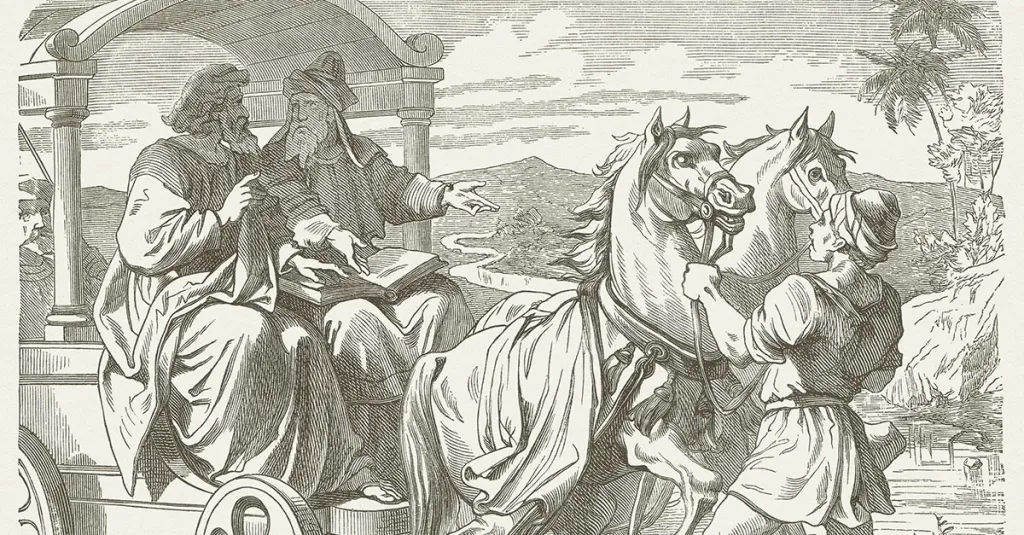
The encounter with the Ethiopian official is one of Scripture’s clearest demonstrations of personal evangelism. The Spirit nudges Philip to approach a chariot. The official is reading Isaiah 53 and asks, “Who is the prophet talking about?”
Philip begins where the man is and transitions to the good news about Jesus—his life, death and resurrection. The official believes and asks for baptism. He is baptized on the spot and continues on his way rejoicing.
Moments like this remind us that God orchestrates timing, conversation and response in ways we could never plan. When we picture Philip the evangelist in the Bible, we see a disciple who keeps Jesus at the center of his life with the Spirit leading the way.
Join with Philip the evangelist in a simple but faithful approach to sharing Christ—listen, explain and invite.
God can orchestrate that timing in our lives as well. We need to be listening for His still small voice when He puts opportunities in front of us.
What We Can Learn from Philip’s Evangelism
Philip is called an evangelist for good reason. He shares the gospel with clarity and courage, and we can learn from his example. We can see them as a process we can adopt together as a community.
- Stay responsive to the Holy Spirit. Philip moves when God prompts him, even when it stalls his momentum in Samaria to take a desert road. We can pray, stay flexible and move when God opens the way.
- Meet people where they are. Philip speaks to crowds and then sits beside one person in a chariot. We value both settings and bring the same patience and attentiveness to each. Some of us may be called to street preaching, others to church planting.
- Start with Scripture. Philip begins in Isaiah. We can learn a few key passages and use them to explain the gospel clearly and kindly.
- Ask good questions. Philip checks for understanding. We can ask, “What do you believe about Jesus?” or “What does this verse say to you,” and invite real conversation.
- Explain Jesus, not just ideas. Philip points to the person and work of Christ. We keep our focus on who Jesus is and what He has done.
- Invite a response. Philip baptizes new believers right away. We can ask gentle, guiding questions and eventually, , “Would you like to trust Jesus today?”
- Live with integrity. Philip’s reputation and Spirit-filled life came first. We pursue holiness, humility and humanity as the context for our witness.
- Partner with others. Philip welcomes Peter and John’s affirmation. We connect new believers to a church family and serve as a team.
As we learn from Philip in the Bible, we find a method that’s adaptable to each of us, whether we’re new believers or seasoned leaders.
How We Apply Philip’s Bold Faith
Philip’s courage comes from trust in Jesus and readiness to obey. We can be encouraged and encourage others when we trust and obey. Following the blessing of seeing others commit their lives to God, we have the pleasure and privilege of nurturing them in their new faith, connecting them with a fellowship of believers and ensuring their spiritual growth through prayer, study and mentorship.
Pray daily for guidance. Ask the Spirit to lead you to one person each day. Keep a simple list of names and follow up with a message or a call. As a body, we can:
- “Practice hospitality. Let’s open our homes for meals and Scripture. Philip’s home in Caesarea nurtured faith and unity; our tables can do the same.
- Carry Scripture in our hearts. Consider memorizing Isaiah 53:4-6, John 3:16, Romans 3:23, Romans 5:8 and Romans 10:9. These verses help us explain the gospel with clarity.
- Listen before we speak. First, we ask what someone believes and why and then we can connect their questions to passages that point to Jesus.
- Use clear gospel outlines. God, sin, Christ, response. Keep it brief, biblical and personal.
- Offer next steps. Invite repentance and faith, offer baptism through our church and suggest reading Luke or Mark together.
- Disciple new believers. Meet weekly for a season to read Scripture and pray, encouraging them to share Christ with others.
- Expect God to work. Philip experiences great joy in Samaria and on a desert road to Gaza. We trust God to move in crowded spaces and quiet places alike.
More About Philip
| Reference | Focus |
| Acts 6:1–6 | Philip was chosen among the Seven, marked by good reputation, wisdom and the Holy Spirit. |
| Acts 8:4–25 | Ministry in Samaria consisted of preaching Christ, signs, many baptisms and joy in the city. |
| Acts 8:26–40 | Philip’s desert road encounter with the Ethiopian official resulted in an understanding of Scripture and his immediate baptism. |
| Acts 21:8–9 | Philip the evangelist now resides in Caesarea with four unmarried daughters who prophesy. |
| Isaiah 52:13–53:12 | This prophecy of the suffering servant was the passage used by Philip to point to Jesus. |
Reading these passages together helps us see Philip in the Book of Acts as a cohesive witness—someone who serves tables, proclaims Christ and nurtures a Christ-centered home. It also reinforces how Philip’s evangelistic practices can be used today.
Simple Tools You Can Use
These are some simple tools that I use when sharing my faith with others. These techniques open spiritual conversations. I have found that people are open to these.
- One question: “What do you think about Jesus?” We’ve found this opens doors.
- One verse: John 3:16 summarizes God’s love and the promise of eternal life in a simple way we can share anywhere.
- One story: Keep a two-minute testimony ready—life before Christ, how you met Him and how He changed you.
- One invitation: “Would you like to trust Jesus today?” Ask gently and clearly and with no expectations. To me, this one takes a big step of faith. But it is worth it!
- One plan: You can invite friends to church, start reading Luke together and meet weekly to pray and talk.
As we use these tools, remember the example of Philip in Acts 8. Don’t rush conversations. Walk with people, listen well and let the Spirit guide you.
Take Your Next Step
Philip shows us how to share Christ with courage. We want to be ready to serve and ready to speak (1 Peter 3:15). As we go through our day, we keep our spiritual eyes open for the person God places in our path. Start with prayer, remember Scripture and point people to Jesus. Don’t be fearful of inviting a response. After all, the results are in God’s hands.
Trust the Holy Spirit to do what only God can do. The story of Philip in the Book of Acts reminds us that God moves on busy streets and quiet roads, in cities and homes, in crowds and one-on-one conversations.
As we live this out together, we carry the legacy of Philip the evangelist into our own neighborhoods and networks today.
So what is your next step? Join with Philip the evangelist in a simple but faithful approach to sharing Christ—listen, explain and invite. That’s a pattern we can all practice, and by God’s grace, it can change lives.
Now, back to my story about the virgin banana daiquiri. The man who came up to talk to me was named Jason.
As we talked more, he opened up. He had been a youth pastor at his church. He told me he had come to the all-inclusive resort hoping to escape his Christian faith for a while—to hide from God and step away from the life he had been living.
But God sent me! I shared with Jason that he can’t hide from God. I was able to share the Bible verses from Psalm 139:7-8 (NIV).
“Where can I go from your Spirit? Where can I flee from your presence? If I go up to the heavens, you are there; if I make my bed in the depths, you are there.”
The next afternoon, when I went to get my virgin banana daiquiri, I saw Jason again. His bags were packed, and he was heading home—back to his Christian life and into the arms of a forgiving and loving Savior.
God used me like He used Philip. He put Jason right next to me, and I just stepped out in faith to speak the truth. Jason responded in faith and made a choice to return to trusting God.

About the Author